
Do We Need Alcohol Free Wine?
I’m frequently told that people are drinking less, though in my line of work I still find that slightly hard to believe.
What I will concede, however, is that alcohol-free options are definitely improving and becoming a lot more popular.
0% beers have come a long way, and even alcohol-free spirits are starting to feel genuinely convincing.
The one category I still haven’t really been won over by, sadly, is wine. It often feels too sweet, too jammy, too artificial. Sound familiar?
Alcohol-free wines feel like they’re trying too hard to be something they’re not.
When studying the WSET courses they talk a lot about the balance of wine. Think of all the components: acidity, fruit, sugar, tannin and alcohol. If one increases, it must be balanced by the others. If not, a wine can taste too harsh and acidic or too clunky and lacking any structure. They don’t necessarily have to be at the same level; they just have to work together and integrate. By now you’re probably seeing the problem. Alcohol is not just there for strength or just for the sake of it. It’s there for structure and texture. If this is taken away, how can a wine be balanced or even a wine at all?
So, what’s the solution?
Not to sound too British, but I’m starting to think the answer might be tea.
Or more specifically, sparkling tea.
What is Sparkling Tea?
Don’t think breakfast tea meets SodaStream! Think more tea champagne.
The process of making it can range through various techniques in the same way that sparkling wine does: traditional method, tank, ancestral etc.
I’ve tried two different brands recently and both are made in very different ways:
REAL slow fermented sparkling tea and Saicho Sparkling tea
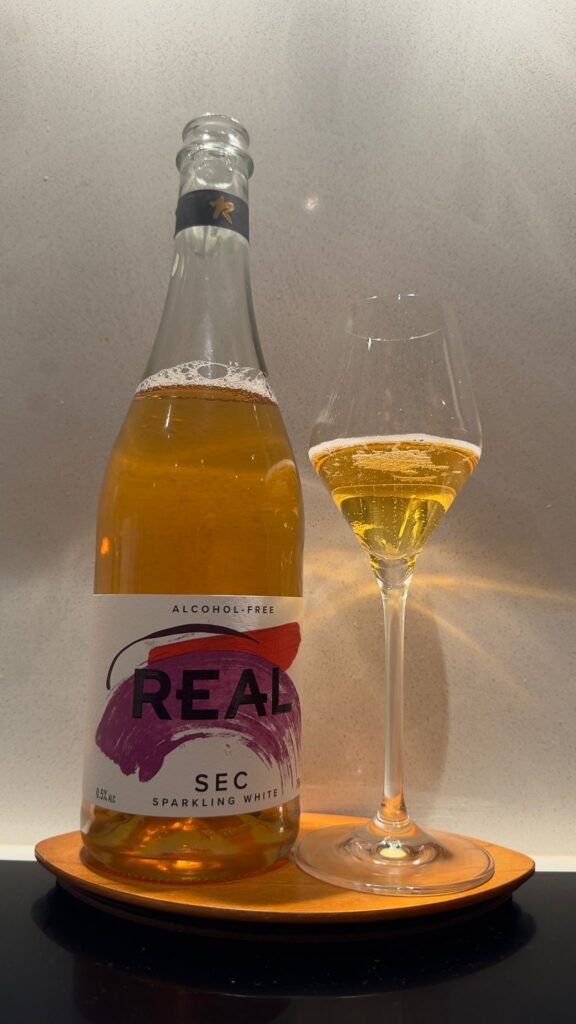
We’ll start with the cheaper of the two, ‘REAL slow fermented sparkling tea’.
Bought in Waitrose for £10.50 (though I’ve seen it available in lots of different places).
The tea I tried was the REAL Sec Non-Alcoholic Sparkling White, which is made from first flush Darjeeling (which is basically just the very first spring harvest of tea leaves from the Darjeeling region of India). Slow fermented just means bacteria and yeast break down sugars over several weeks or longer. It gives more complexity and adds some more ‘distinct’ flavours.
For the more interesting stuff, what does it taste like?
The first flavour I was hit with was really strong stone fruits: peach, mango, nectarine. This then suddenly changed to the more floral flavours of the tea itself and something slightly nutty. This is when it went a bit different. Not bad different, not good different, just different. The finish throws out a slightly vinegary, slightly yeasty flavour. Obviously, with the way this drink is fermented, it’s nothing unexpected; it’s just with the really fruity initial flavour the contrast leaves your mouth feeling a bit stale.
If you are a fan of kombucha this style will be for you; it’s just a lot more subtle and more refined. As someone who loves pét-nat wines, I had expected to like this style, but I have to admit it did take a few glasses for me to get used to the funky aftertaste.
There’s nothing bad about it; it’s just very unique. It’s something you need to try to see if it agrees with your palate.
In any case, I still think it’s a better option than the majority of the alcohol-free wines I’ve tried.
As well as this flavour they also do Real Dry, which is pan-fired Dragonwell green tea, and Real Blush, Darjeeling and White Peony loose-leaf teas, with red grape skin.
I’ve tried the Real Dry and it’s similar to the Real Sec. There are more citrus fruit flavours and the tea flavours are different due to the different type, but the style is the same.
Thinking about food pairing, we just so happened to be eating crispy duck, which against all odds went incredibly well. This makes me believe it will go well with richer, umami-driven foods and meats. Even shellfish or fish with a rich sauce will pair well.
Moving on to the next:
Saicho Sparkling Jasmine Tea
Bought on their website for £19.99
Although I did buy and try again for this post, I had actually tried the Saicho tea a while back. A restaurant in a hotel I was working at had a Michelin-star restaurant with the option of an alcohol-free ‘wine flight’. The sommelier at the time gave me a glass to try out of the blue as it had just been added to the list. The initial sip took me by surprise. The flavour profile was so striking, such a distinctive jasmine flavour. There was no reliance on sweetness, but a perfect balance of floral, fruits and light carbonation, even a hint of tannin. There’s no sense of something missing, like there so often is with low and no wines.
The one I tried in the restaurant was the Jasmine tea, but they also have Hojicha, Darjeeling and Osmanthus (which I’m yet to try).
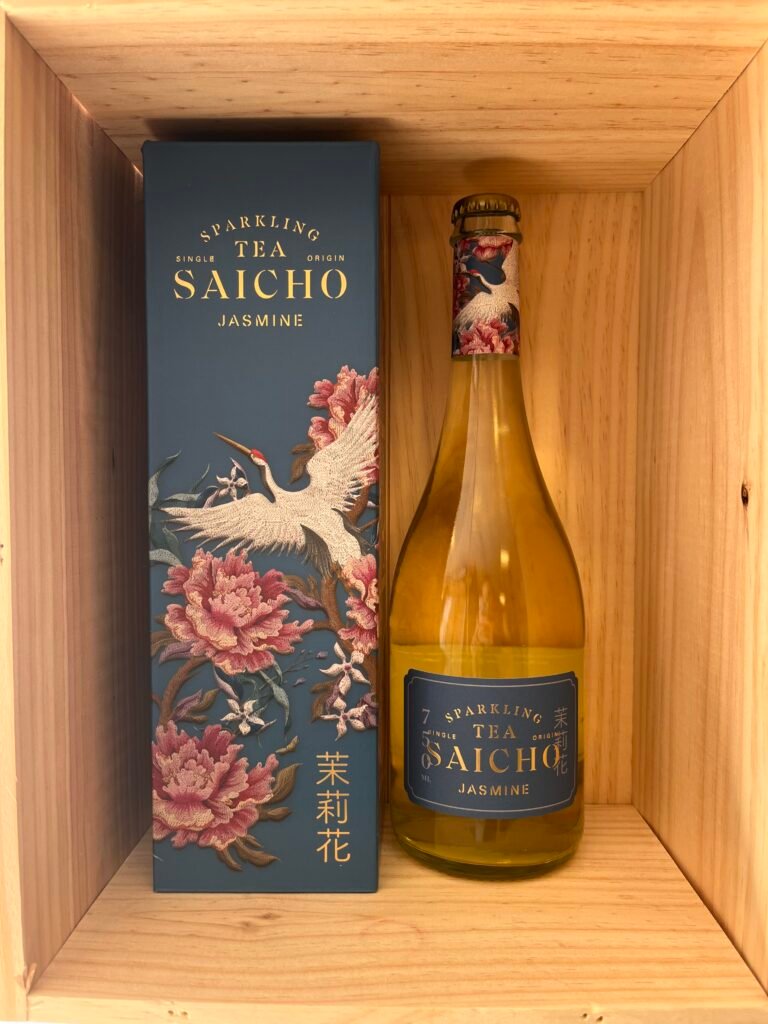
As I mentioned previously, Saicho is made with a different method to REAL.
The tea is cold brewed for an extended period to extract all the flavour and tannin. You lose the bitter flavours that you would have got through brewing with higher temperatures.
It is then mixed with different ingredients depending on the expression: grape juice, botanicals etc.
Unlike the fermentation method, the bubbles are added through carbonation and it is bottled under pressure. It leaves you with a much cleaner taste and less of the funky vinegar.
Due to the difference in style, I think it will go much better with lighter dishes: seafood, salads or aromatic but delicate foods like sushi, summer rolls, tempura.
The elephant in the room.
Nearly £20 for a drink with no alcohol? You can’t deny it’s dangerous territory. Saicho tea has a very luxury-heavy focus. It’s advertised in a way similar to that of real champagne and they rely heavily on Michelin-star or luxury hotel placements. But is it all clever marketing or does the product justify the price?
Yes and no.
I’m not going to compare it to Champagne or any other kind of sparkling wine as that’s not really the point. I think I’ve made it clear I love this product: it’s well balanced, unique, the packaging is gorgeous, it tastes amazing and, more importantly, it doesn’t taste like an expensive compromise. It stands on its own. Would I be drinking this every day? No. Would I order this for a special occasion? Yes.
Both REAL and Saicho may both be branded under the sparkling tea umbrella, but both work in their own way to fill a gap in the market.
In the end, I’m not sure it’s useful to ask which is better. They’re not really competing or even in the same game. It’s just interesting to see what options are out there.
Although neither of these are technically alcohol-free wine, they feel like a start. They show that genuinely interesting, high-quality alcohol-free drinks are possible.
And maybe the bigger point is that we don’t necessarily need better alcohol-free wine, we just need to be more creative about what comes next.